
Dentures – Dallas, TX
Beautifully Rebuilding Your Compromised Smile
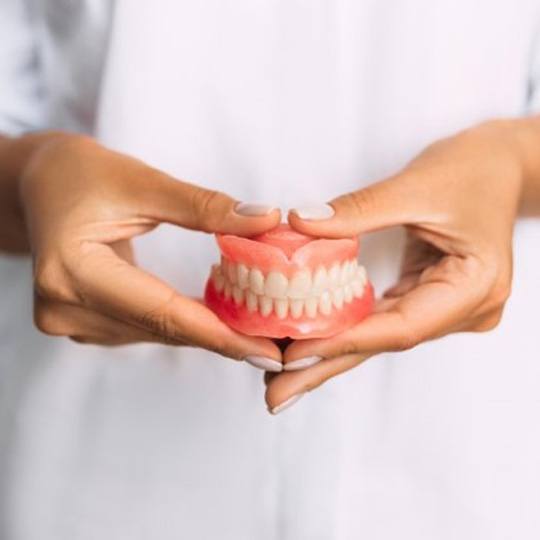
Missing just one tooth can be pretty problematic—but when you’re missing one or both arches of teeth, you’re really in trouble! Not only is the appearance of your smile negatively impacted, but you’ll struggle to perform basic daily tasks like biting, chewing, and even speaking. Fortunately, here at Soleil Dental, we’re able to assist patients with several missing teeth using dentures, one of the most tried-and-true tooth replacement options around. Using these lifelike prosthetics, we can beautifully rebuild your compromised smile! Keep reading below to learn a little more about what dentures in Dallas are capable of, or feel free to give our team a call today to schedule your consultation.
Why Choose Soleil Dental for Dentures?
- Friendly Dentists with Years of Experience
- Comfortable Office with Modern Amenities
- Beautiful Restorations You’ll Love Showing Off
Who's a Good Candidate for Dentures?

Dentures are quite versatile since they can assist patients who are missing just a few, many, or all of their teeth. In most cases, patients with extensive tooth loss are eligible to receive dentures, but you’ll still need to see us at our Dallas office beforehand so we can assess your situation. During this consultation, we will inspect your mouth to determine which type of denture best suits your needs as well as if there are any preparatory procedures that need to be completed beforehand. In some cases, patients with existing oral health issues like gum disease or tooth decay will need to undergo treatment before they can be outfitted with their dentures.
Effects of Missing Teeth
Tooth loss is one of the most common health problems throughout the world, and it can cause a wide variety of problems. Teeth can be lost due to oral infection or injury or even illness in other parts of the body, and empty spaces in your smile can lead to facial sagging, speech difficulties, digestive trouble, and even lower self-esteem. These effects can lower your quality of life by limiting the foods you can eat while leaving you less confident in social situations.
What Qualifies You for Dentures?
Dentures can be an excellent option for patients who have extensive tooth loss, sensitive teeth, or severe dental decay as long as they have healthy gum and jawbone tissue. Dentures also require patients to adhere to a thorough hygiene and maintenance regimen to stay in good shape. Since dentures can be more affordable than other tooth-replacement options, they can be great for patients on a budget.
The best type of denture for you depends on your oral health situation. If you are missing several teeth throughout your mouth, a partial denture may be the best way to complete your smile, but a full denture is probably the best bet for those who are missing an entire arch of teeth. If you’re looking for a secure hold that gives you maximum chewing force, implant dentures may be the ideal option for you.
Alternative Tooth-Replacement Options
Since dentures aren’t the best option for all patients, the team at Soleil Dental offers several other tooth replacement appliances. These include:
Dental bridges: Designed to replace one or several missing teeth in a row, bridges are secured with crowns placed on healthy teeth or dental implants placed in the jawbone on either side of the gap.
Dental implants: These devices are surgically implanted in the jawbone and fused with its structure through the natural process of osseointegration, allowing dental restorations mounted upon them to feel and work exactly like real teeth. While this option is more expensive than traditional dentures, the results can last for a lifetime with excellent care.
Types of Dentures
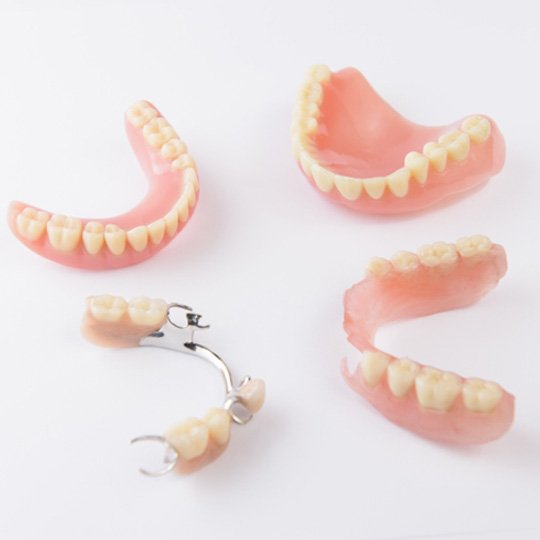
Since everybody experiences tooth loss differently, there are various types of dentures that are capable of assisting with different situations. And thanks to constant advancements in dental technology, these restorations are more natural-looking and comfortable to wear than ever before! Here’s more about a few of the options we might recommend for addressing your tooth loss:
Partial Dentures
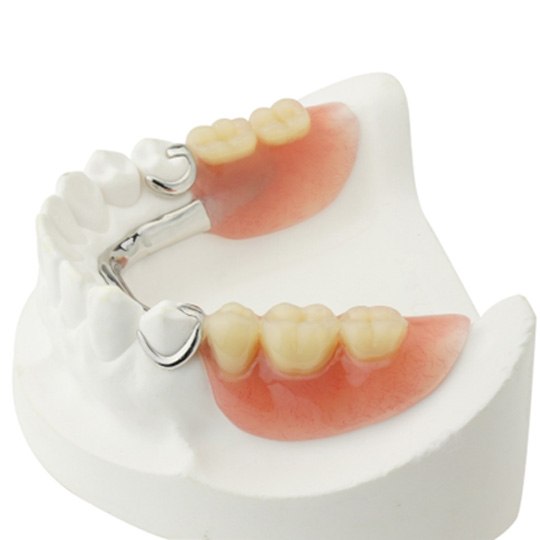
For patients missing several teeth in a row, but not an entire arch, partial dentures are often recommended. These are crafted from a gum-colored acrylic base supported with metal and combined with lifelike prosthetic teeth, and they’re designed to fit around your existing teeth with the assistance of anchoring clasps. They can be removed for cleaning, making them relatively convenient and easy to care for.
Full Dentures
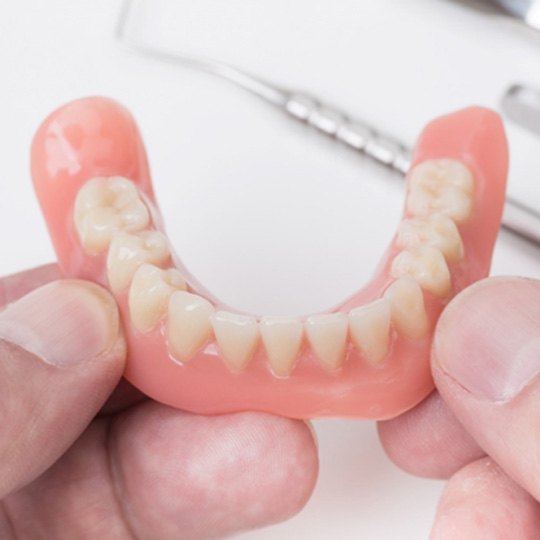
Full dentures are ideal for when a patient is missing an entire arch (or two) of their teeth. They also utilize discreet, gum-colored bases like their partial counterparts; however, the way they’re anchored differs. They rely on a combination of muscle control, suction, and denture adhesives to remain in place. This solution can improve your bite power and overall quality of life dramatically!
Implant Dentures
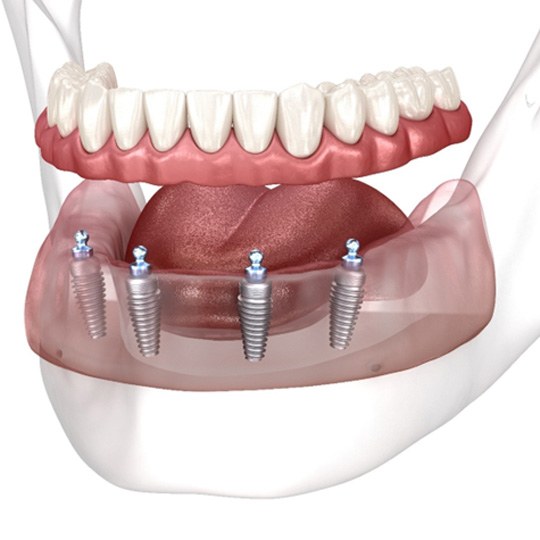
Implant dentures combine the practical usefulness of dentures with the unique and advantageous properties of dental implants! Using small titanium posts that are surgically placed below the gumline and directly into the jawbone, the roots of missing teeth can be fully replicated, which in turn provides unwavering support for your new restorations. And the best part is that people won’t even be able to tell that you’ve had your smile rebuilt unless you inform them yourself!
How Dentures Are Made
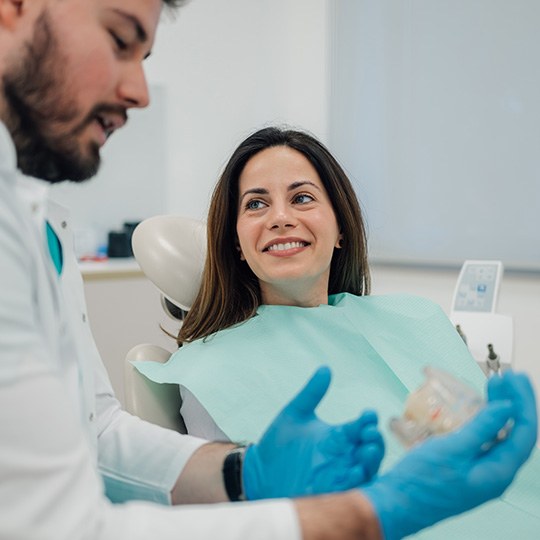
Modern dentures aren’t like the ones that your grandparents used to wear. They are customized for each patient with the highest quality of materials available. To achieve a prosthetic that suits your smile more perfectly, getting dentures requires a multi-step process. Read on to learn more about dentures, what they are comprised of, and the process necessary for your unique smile.
What Are Dentures Made Of?
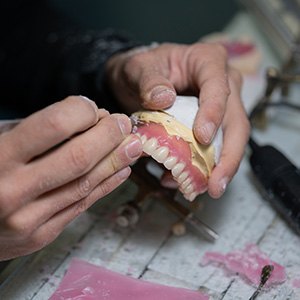
Dentures are made up of two parts – the base and the replacement teeth. Here’s what each one looks like.
- Base: The base of the foundational structure of the replacement teeth. It can be made from various materials, but acrylic tends to be the most popular option because it looks so much like natural teeth.
- Teeth: Most of the time, the replacement teeth are attached to the base of the dentures and are made from either resin or porcelain. These materials look similar to real tooth enamel.
The Denture Creation Process
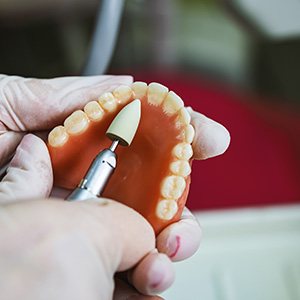
All dentures are customized, so everyone’s treatment plan looks a little bit different. Here is what the process typically consists of.
- Measurements are taken of the jaw, and impressions are made of the upper and lower gum tissue. These are used to create a plaster model of your mouth.
- The model is sent to the dental lab where your dentures are created. First, your replacement teeth are set in place with an articulator. Then, adjustments are made by a lab technician.
- The wax dentures are sent to your dentist for a fitting. If everything looks and feels great, your dentures are returned to the dental lab so the process can be completed.
- After the dentures have returned to the lab, the wax needs to be replaced with acrylic. To do this, the lab tech places the dentures in a flask. Plaster is poured in to maintain the shape of the dentures. The whole flask is placed in hot water to melt away the wax.
- The plaster is cut from the dentures with dental tools. Then, the dentures are placed in an ultrasonic bath to wash away the remaining texture.
- Excess acrylic is cut from the dentures. Then, they are polished to perfection.
- The dentures are returned to our practice. If you and your dentist are happy with the results, you can leave showing off a beautiful, complete smile.
Adjusting to Your New Dentures

When you first get your new prosthetic, you might notice some soreness. This is normal as your mouth adjusts to your new smile. Your dentures will start to feel more natural over time. When you first get your dentures, it is ideal to stick to a soft diet and exercise your facial muscles. As you become more comfortable eating with your dentures, you can start to introduce tougher foods. If discomfort persists or you have concerns, let us know so we can help.
The Benefits of Dentures
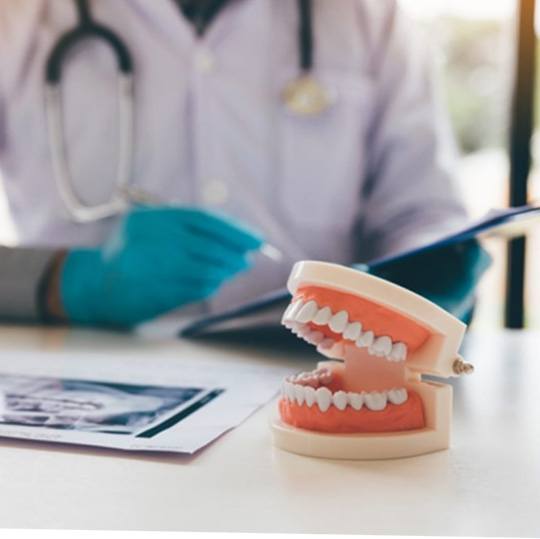
There are countless benefits that you unlock access to when you decide to restore your smile with dentures. Here are just a few of these notable advantages:
- They effectively restore your ability to bite, chew, and speak
- They’re fully customized for you, meaning they’ll look and feel natural
- Dentures can last for 7+ years with good maintenance, and they’re quite easy to care for
- They’re considered very cost-effective
- They help to preserve a more youthful facial shape
Denture FAQs
Will I Need to Have Teeth Removed for Dentures?
Dentures are the tried-and-true solution for tooth loss because they’re an effective and versatile way to rebuild smiles, regardless of how many teeth are missing. For instance, if you’ve lost several but not all, then a partial set can restore your arch(es) to improve your mouth’s function and appearance.
But full dentures must form a tight suction against your gum tissues to remain in place, so if you have lost most of your teeth but have a few stragglers left, they might require extraction for your restoration to be successful. Our team will need to examine your current condition to determine whether preliminary services, such as removals, are necessary before proceeding.
What Are Dentures Made From?
These prosthetics consist of two main components, which can each be made from different materials. For instance, the base provides the foundation for your artificial teeth and is typically made from gum-colored acrylic or resin that can be colored and carved to resemble your natural connective tissues.
The teeth are usually crafted from resilient ceramic, such as porcelain, which can be carefully customized to match your enamel for beautiful results that boost your confidence. This material is also strong enough to withstand the daily pressures of biting and chewing, but won’t develop cavities like the teeth you were born with.
Can I Sleep With My Dentures In?
If you’re absent-minded or forgetful, you might accidentally fall asleep with your new teeth still in your mouth. While this might not be harmful if it happens once or twice, it’s generally not recommended. Your dentures rely on a firm suction against your connective tissues to remain in place, which can reduce circulation in that area. This increases the risk of developing sores, gum disease, or other oral issues.
You can avoid this by removing your dentures to thoroughly brush them at night, rinse them, then leave them in a glass of room-temperature water or a special soaking solution to eradicate germs and maintain their shape overnight as you rest.
Am I Too Young for Dentures?
Some patients associate dentures with aging because tooth loss is more common among seniors. For example, sources report that an estimated 33% of adults aged 20 to 39 have lost at least one tooth, compared with nearly 66% of those aged 40 to 64.
But the leading cause of tooth loss, periodontitis (advanced gum disease) can potentially affect people at any stage of their lives. The same is true of severe tooth decay or physical trauma, which can also damage or dislodge one or more teeth. Thankfully, there are no age requirements or restrictions for getting dentures, and your candidacy is based more on your dental condition on a case-by-case basis.
I Need a Checkup & Cleaning I Need a Dentist for My Child I am Concerned About Bleeding Gums I am Missing One or More Teeth I Want to Enhance My Smile I Want a Straighter Smile I am Scared of the Dentist I am in Pain & Need Help I Need My Wisdom Teeth Removed I Have Pain in My Jaw View Our Services