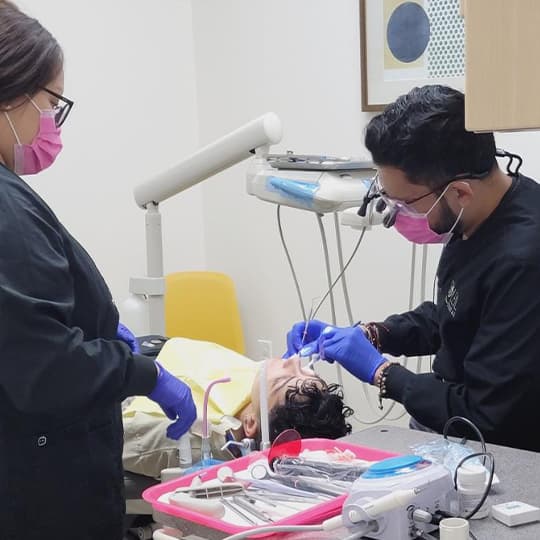
Gum health
Bleeding gums are worth a closer look.
Gums that bleed when you brush aren't normal, even if it's been happening for years. It's usually the first sign of gum disease, and caught early it's very treatable. At Soleil we check your gums at every exam, explain what we find in plain words, and treat it with deep cleaning and a plan to keep it under control.

What is gum disease?
Gum disease starts with plaque, the sticky film of bacteria that builds up along your gumline. If it isn't brushed and flossed away, it hardens into tartar, which only a dental cleaning can remove. The bacteria irritate your gums, and your body's reaction to that irritation is what causes the damage.
It comes in two stages. Gingivitis is the early, reversible one: red, puffy gums that bleed easily. Periodontitis is what happens when it goes further, and the gums and bone that hold your teeth in place start to break down. Periodontitis is one of the most common reasons adults lose teeth.
What are the signs of gum disease?
Gum disease is often painless, which is why it's easy to miss. Watch for:
- Gums that bleed when you brush or floss
- Red, swollen or tender gums
- Bad breath or a bad taste that doesn't go away
- Gums pulling back, so teeth look longer
- Teeth that feel loose or are shifting
- A change in how your teeth fit together when you bite
How we check your gums
At every checkup, we gently measure the small space between each tooth and the gum. Healthy gums have shallow pockets. Deeper pockets mean the gum has started to pull away and bacteria have more room to hide. X-rays show us whether the bone around your teeth has changed.
We'll show you your numbers and photos and tell you honestly which stage you're in. No lectures. Plenty of people have some gum disease, and the point is to get it under control.
Treating gingivitis
If it's caught at the gingivitis stage, the fix is usually simple: a professional cleaning to remove the tartar, and better daily habits at home. We'll look at how you brush and floss and suggest small changes, like a softer brush, a better flossing technique or a water flosser. For most people, the bleeding calms down within a few weeks.
Scaling and root planing: what is a deep cleaning?
Once tartar and bacteria are below the gumline, a regular cleaning can't reach them. Scaling and root planing is a deeper cleaning that can. We numb the area first, then carefully remove tartar and bacteria from the tooth roots under the gums (scaling) and smooth the root surfaces (root planing), so the gums can heal and tighten back around the teeth.
Deep cleanings are often done one section of the mouth at a time, over one or two visits. Your gums may be tender and a little sensitive for a few days. Warm salt water rinses and a soft brush help.
Keeping it under control
Gum disease can be managed, but it tends to come back if it's left alone. After a deep cleaning, most people do best with maintenance cleanings more often than twice a year, often every three to four months. We'll re-measure your gums and adjust the plan as they improve.
Some cases need more than a dental office can offer. If your gums or bone need surgical care, we'll refer you to a periodontist, a gum specialist, and keep caring for the rest of your smile here.
Your gums and the rest of your health
Research has linked gum disease with other health conditions, including heart disease, respiratory problems and diabetes. Diabetes in particular works both ways: it makes gum disease more likely, and untreated gum disease can make blood sugar harder to control. Smoking, vaping, pregnancy and some medications can also raise your risk.
That's one more reason we check your blood pressure and ask about your health history at checkups. Tell us about any changes, even ones that don't seem dental.
Gum care around implants, bridges and dentures
Implants can't get cavities, but the gum and bone around them can get a similar infection, called peri-implantitis, and it's a leading reason implants fail. The same goes for teeth that hold up a bridge or a partial denture: healthy gums keep everything stable. If you have any of these, your gum checks matter even more. Our office in Oak Lawn sees plenty of people in exactly that spot.
Planning veneers, dentures or implants? They all start with gums in good shape, so treating gum disease often comes first.
How it goes
Measure
A gum check, x-rays and photos, with your numbers explained.
Deep clean
Scaling and root planing with the area numbed, often over one or two visits.
Maintain
Maintenance cleanings, often every three to four months, to keep it in check.
What it costs
Cost depends on how many areas of your mouth need a deep cleaning and how often you'll need maintenance visits afterward. You'll see the plan and the price before we begin. Most PPO plans help with part of the cost. We check your benefits before treatment, and Sunbit and Cherry offer monthly payment plans. No insurance? The Sunshine Membership is $119 a year and takes 20 to 30% off treatment, depending on the procedure (conditions apply).
Insurance and financingYour dentists
 Dr. Jose AldanaCo-owner. UNT and Texas A&M Baylor College of Dentistry.
 Dr. Diana VazquezCo-owner. SMU and Baylor College of Dentistry.
Both doctors treat gum disease, and a gum check is part of every exam. They'll plan your treatment with you, in English or Spanish, and if you need a gum specialist, we'll help with the referral.
Questions