Restore
Close the gap with a bridge that blends right in.
A dental bridge fills the space left by one or a few missing teeth, anchored to the teeth on either side or to implants. It's fixed in place, it doesn't come out at night, and when it's done well, nobody can tell which tooth is the new one.

What is a dental bridge?
A bridge is a set of connected teeth made as one piece. The replacement tooth in the middle is held up by crowns on the teeth next to the gap, or by implants. Once it's cemented, it works like a continuous row of teeth: you bite, chew and brush it like the rest of your smile.
Bridges are usually the answer for one to three missing teeth in a row. For longer gaps, or teeth missing in different parts of your mouth, a partial denture or implants tend to be the better fit.
Traditional bridge or implant bridge?
There are two main ways to hold a bridge in place:
- Traditional bridge: crowns go on the two neighboring teeth, and the replacement tooth sits between them. No surgery, and it's usually finished in two visits.
- Implant bridge: implants take the place of those anchor crowns, so your natural teeth are left alone. It takes longer, because the implants need time to heal, but it doesn't lean on your own teeth.
When a traditional bridge makes the most sense
If the teeth next to the gap already have large fillings or old crowns, covering them with new crowns can actually help them. That's a traditional bridge at its best: it replaces the missing tooth and protects the neighbors in the same step.
If those neighbors are healthy and untouched, we'll talk honestly about the tradeoff. Shaping healthy enamel for a crown is permanent, and an implant might be the more conservative choice. We'll show you both options on your own x-rays and photos.
Why replace one missing tooth at all?
It's tempting to leave a gap alone, especially in the back where nobody sees it. Over time, though, the teeth around a space tend to drift and tip into it, and the tooth above or below can start to grow into the gap. That can change your bite, trap food and make cleaning harder.
You also lose chewing power on that side, and the bone where the root used to be slowly shrinks. Replacing a tooth sooner usually keeps your options simpler and your treatment smaller.
Bridge, partial or implant: how they compare
For a gap of one to a few teeth, here's the honest comparison:
- A bridge is fixed, feels solid and is usually done in a few weeks. It relies on the neighboring teeth for support.
- A partial denture is removable and usually the most affordable, and it can replace teeth in different spots at once.
- An implant stands on its own, doesn't touch the neighboring teeth and helps preserve bone. It takes months and costs more up front.
What happens when you get a bridge
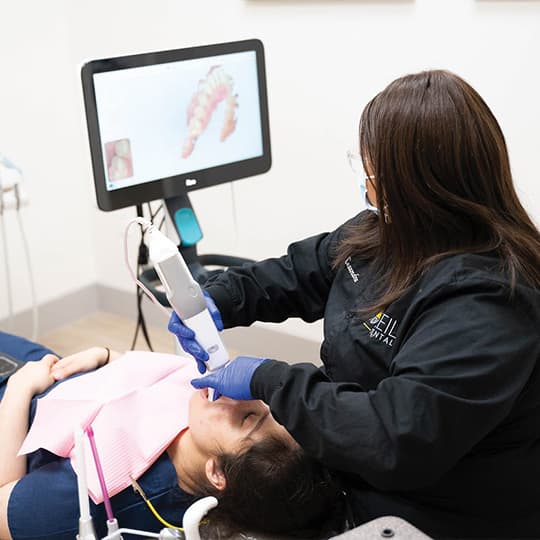
At the first visit we numb the area and shape the anchor teeth so the crowns can fit over them. Then we take a digital scan instead of a tray full of impression putty, and you leave with a temporary bridge while a dental lab makes the final one.
At the second visit, usually a couple of weeks later, we take off the temporary and check the new bridge for fit, color and bite before cementing it. Implant bridges follow the implant timeline first, planned with 3D imaging.
Picking the material
Bridges can be made from tooth-colored ceramics like zirconia, E.max or porcelain, from porcelain over a metal base, or from gold. Near the front, we lean toward materials that let light through like natural enamel. In the back, strength matters most.
We match the shade to your teeth and explain why we're recommending one material over another. If you're planning to whiten, do it before the bridge is made, since ceramics don't change color.
How to care for a bridge
A bridge can't get a cavity, but the teeth holding it up can, especially right at the gumline. Brush twice a day and clean under the replacement tooth every day with a floss threader, a water flosser or a small brush made for between teeth. We'll show you how at your appointment.
Skip chewing ice and hard candy, and if you grind at night, ask about a custom nightguard. Keep your six-month checkups so we can catch a problem at the edge of a crown early. With good care, many bridges last ten years or more.
How it goes
Plan
An exam, x-rays and your options, bridge, implant or partial, with cost.
Prepare
The anchor teeth are shaped and scanned, and you leave with a temporary.
Place
A couple of weeks later, the final bridge is checked, adjusted and cemented.
What it costs
Bridge cost depends on how many teeth it spans, the material, and whether it's held by crowns or implants. You'll get a written estimate first. Most PPO plans help with part of the cost. We check your benefits before treatment, and Sunbit and Cherry offer monthly payment plans. No insurance? The Sunshine Membership is $119 a year and takes 20 to 30% off treatment, depending on the procedure (conditions apply).
Insurance and financingYour dentists
 Dr. Jose AldanaCo-owner. UNT and Texas A&M Baylor College of Dentistry.
 Dr. Diana VazquezCo-owner. SMU and Baylor College of Dentistry.
Both doctors plan and fit bridges. When implants are the better anchor, they're placed right here and planned with 3D imaging.
Questions